Wide Open Days
There is something very special about bright and warm spring days spent almost entirely outdoors. Taking advantage of wake-up temperatures already in the 60s, we headed outside early with a fully stocked picnic basket, books, and a plan to spend most of the day playing outdoors, in nature.
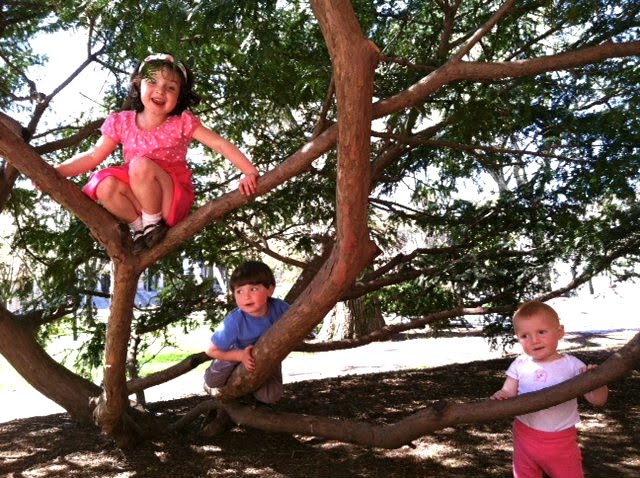
We spent a long while in a quiet corner of nearby Harvard Yard. My littlest one napped in the fresh air while the big kids climbed trees, played hide-and-seek in the shrubs, and made up their own creative games underneath shady branches and in hidden corners in front of old buildings.
While picnicking, we said hello to a passing acquaintance and her children. She remarked that she had been neglectful in not planning well for this April school vacation week and was seeking ways to fill their days to stave off boredom. As I write this week about "natural learning" ahead of Sunday's Earth Day celebration, this conversation reminded me of a fantastic quote in Richard Louv's book, Last Child in the Woods: "We need to draw an important distinction between a constructively bored mind and a negatively numbed mind. Constructively bored kids eventually turn to a book, or build a fort, or pull out the paints (or the computer art program) and create, or come home sweaty from a game of neighborhood basketball."
As parents, we can sometimes be overly-focused on making sure our children's days are fully enriched with dynamic classes and activities to keep them from being bored, when, in fact, boredom--and the important ability to overcome it independently--can be an even greater lesson for our children. I think that if we parents can overcome our anxiety about our children's potential boredom and unstructured time, then we will see that children have an amazing talent for making their own play, for finding interesting ways to occupy themselves, for unleashing their imagination -- especially outside, in the natural world, on warm, wide open April days.
Louv reminds us how important it is to understand and embrace boredom. He states: "Most of all, children need adults who understand the relationship between boredom and creativity, adults willing to spend time in nature with kids, adults willing to set the stage so that kids can create their own play and enter nature through their own imagination." There is so much to do on these wide open April days, so much nature to explore, so many trees to climb, so many opportunities to create, to wonder, to dream.
From Natural Parenting to Natural Learning
Families are drawn to homeschooling for a variety of reasons, but for many families who believe in the ideals of "natural parenting," ours included, homeschooling is an obvious extension of this chosen lifestyle. Natural parenting is a broad term that encompasses many parenting practices aimed at being as natural, ecologically sustainable, and holistic as possible. It includes practices such as natural birth and breastfeeding, organic and sustainable food and consumption habits, cloth diapering or elimination communication, homeopathic and holistic family care, attachment parenting, and natural learning.
It is not surprising that as a growing number of new parents embraces natural parenting, these parents eventually become inspired by the idea of natural learning and homeschooling. Our early closeness and connection with our children helps us to develop positive, trusting relationships with each other. As natural parents, we are deeply aware of our children's needs, strengths, and limitations, and we use this knowledge to guide our parenting approach in the early years. As our children grow, we notice their innate gifts and passions unfold and we follow their lead, their unrelenting curiosity, as they learn and discover.
Most significantly, natural parenting focuses on trust: trust in our own powerful parenting instincts and abilities, and trust in our children to lead us, to show us what they need to learn and grow and reveal their true talents. Homeschooling extends this natural parenting and natural learning process beyond infancy and toddlerhood. It builds family trust and strengthens family relationships, and it grants children the uninterrupted freedom to learn and grow in their own, natural, intended way.
As an important extension of natural parenting, many natural learning families also place significant emphasis on learning from, growing in, and caring for the natural world. Through ecologically sustainable homemaking practices and extensive time spent outdoors, in nature, natural learning families prioritize their critical connection to the natural world. Homeschooling offers the gift of vast amounts of free, unstructured, exploratory time to learn from nature.
In Last Child in the Woods, author Richard Louv states: "The boundaries of children's lives are growing ever tighter." A commitment to natural learning and time spent connecting our children to the earth, loosens these boundaries, unlocks our children's spirit, and widens our trust in nature's wisdom.
The Natural Family Living Movement
We read about it in articles citing increasing rates of homeschoolers, and rising numbers of homebirthers. We see it in neighborhood gardens and backyard chicken coops. We notice it in consistently sold-out local courses on knitting, and sewing, and other handiwork. We hear about it in conversations with friends and neighbors seeking a return to times of simpler homemaking, times when vinegar was the go-to cleanser, when sunshine was the greatest disinfectant, and when growing and preserving food were part of the seasonal rhythms of each family. We feel it in the growing demand for alternative, holistic healthcare solutions for families, and for greater trust in natural healing. It's all around us, this reconnection with do-it-yourself homemaking and natural family living.
We all arrive at our focus on natural family living from different places and for different reasons. For some of us, it is a rejection of the way things are and for others it is an acceptance of the way we think things ought to be. I've mentioned before that while I started on the natural parenting progression when I became a mom, embracing Attachment Parenting principles, discovering cloth diapering, and becoming passionate about homeschooling, it wasn't until my daughter's homebirth a bit over a year ago that I became truly awakened to the magnitude of what we are able to accomplish within our homes, within our families. I began to more seriously question mainstream parenting and homemaking practices, and reclaim home as the center of family life.
This week, I will be presenting posts highlighting natural family living and do-it-yourself homemaking, including some guest posts. I would love to hear how and why you have embraced natural family living. And if you would like to guest-post on this topic, please let me know!
My Little Baker
Whether or not my five-year-old will follow in the footsteps of locally-acclaimed Flour Bakery chef and owner, Joanne Chang, who has a degree in Applied Mathematics from Harvard, she is consumed by all-things-baking lately. She devised a "Special Secret Cake Recipe," selecting all of her ingredients and measurements herself, and today she put her creation to the test. It may not be the fluffiest cake, but it is definitely the best I've ever tasted...
2 eggs
1 cup sugar
3 cups of flour
1/2 cup milk
1 tsp vanilla
1/2 stick of butter
Big mixing spoon
Mix all ingredients together. Put in oven. Bake at 350 until done.
March Madness: Considering the Homeschooling Option
For many families who receive a preferred lottery placement or a top-choice private school placement for September, the decision-making process is over. But for other families who were not assigned or admitted to a top-choice school, the decision-making process has just begun. Some families will grow satisfied with their lower-choice schools, others will bide their time on the wait-list and hope for a top placement in the fall. Some families will leave their urban lifestyle for the suburbs and neighborhood schools. And an increasing number of urban families will look more seriously at the homeschooling option.
Here is my quick list of homeschooling highlights for families considering this education option:
3. Homeschooling creates community. One of the first things a prospective homeschooling family should do is become involved with its local homeschooling community, participating in its online message board and attending local park days and other homeschooling community activities. This process will help families to clarify their homeschooling ambitions and build relationships with other homeschooling families.
4. Homeschooling strengthens families. Homeschooling positions family at the center of a child's education, charting a new paradigm for living and learning together as a family unit in an exciting and meaningful way.
5. Homeschooling maximizes city resources. Homeschooling enables families to take full advantage of the vast resources of the city on a regular basis, and use these resources daily to create enriching, inspiring, informative learning experiences for children.
6. Homeschooling individualizes and celebrates learning. Homeschooling allows families to tailor learning and teaching approaches to each child's specific learning needs and interests, allowing skills to naturally unfold, strengths to naturally emerge, and curiosity to naturally lead the way.
7. Homeschooling grants time and space. Homeschooling bestows the gifts of time and space: time and space for children to discover their inborn gifts and true passions; time and space for families to live and learn together in a simpler, more unhurried way; time and space for young learners to grow and develop in their own time, in their own way, with their parents guiding, encouraging, and marveling at it all.
At the beach
When a week-long gift of record-breaking warmth is sent to New England, in March, we embrace it with full gratitude and vigor. Today, as temperatures climbed into the 80s here in Boston, the kids and I hopped onto the subway to a nearby urban beach to soak in this perfect day.
Days like this one, bright, warm, full days when my children can dig, and splash, and build, and wander--especially when the calendar has us shaking our heads--make me truly grateful for the freedom and flexibility of a homeschooling lifestyle.
They also remind me how, in just a few short months, my children have grown. Instead of eating sand, my youngest is now digging in it. Instead of racing off fearlessly into the ocean, my three-year-old first dips in a toe. Instead of building sand castles according to her own rules, my five-year-old considers ways to involve her little brother. Lots of changes since October.
And yet, they are still little, so little. Too little to fully appreciate the gift of a March beach day in New England. Luckily I can.
Choosing a Slower Childhood
I was struck recently by this quote in an article written by Simplicity Parenting author, Kim John Payne: "Ultimately, it comes down to a choice. Parents need to decide whether they believe childhood is a fast-paced enrichment opportunity or a slowly unfolding experience."
We choose the slow and simple. And yet, a slow and simple childhood in today's increasingly fast and complex world is a choice that needs constant vigilance. So many fascinating activities and exciting children's programming here in the city could easily sweep us off our feet and consume the precious time my children have to just be--to imagine and create and grow--slowly and steadily.
On summer-like days here in March, unexpected and entirely welcomed, I am reminded more prominently of the gift of allowing childhood to be a "slowly unfolding experience." Spending nearly all of our daylight hours outside, drinking in the sunshine and warmth, I can almost see childhood unfolding naturally, peacefully. I can see siblings collaborating on important backyard projects. I can hear whispers of fairies and magic and all that's possible. I can watch trees get climbed, feet get muddy, sticks get transformed, dreams get planted.
I observe this quiet unfolding of childhood, just as the crocuses and daffodils quietly unfold around us, and marvel at its simple, uninterrupted beauty. In truth, it's really only been in the last few years that I have truly seen spring unfold: deeply and intentionally noticed the first buds, the first burst of color. It was in these last few years that my children introduced to me a slower, more deliberate pace--a pace necessary to spot each new bud and petal. My children are completely enchanted by spring's new discoveries and force a stiller, steadier, more observant rhythm to appreciate all that emerges around us.
I learn from them. I learn to go slower, to notice more, to appreciate more, and to protect the extraordinary unfolding of childhood.
Acceptance or Rejection?
Are you accepting something for what it promises, or rejecting something for what it fails at?
I have been fascinated by the responses, both here and on the blog's Facebook page. Some of you indicated that, with respect to homeschooling, you are completely accepting, others passionately rejecting, and others neither accepting nor rejecting.
This leads me to another similarly provocative question related specifically to homeschooling:
How do you think your homeschooling perspectives and approaches might vary if your children were once enrolled in a traditional school compared to if your children were always home-schooled?
If your children were enrolled in traditional school, for example, do you feel more comfortable following an established curriculum to retain the rhythms of a traditional school-day, or do you reject the traditional school rhythms and seek something completely different? I am curious to hear your responses, here and on Facebook.
My children have never attended traditional school and we committed to homeschooling when my oldest was only two-years-old, so my perspectives on life learning and unschooling have blossomed naturally from watching how my children learn. Beginning in toddlerhood, we became active in our local homeschooling community, particularly young homeschooler playgroups, and my kids have developed friendships with other similar-aged homeschoolers that have endured over the past several years. We feel completely free to follow our own learning path, uncovering the children's passions and gifts as we go, and see homeschooling as a natural extension of our family rhythms and child-rearing philosophy.
I wonder how different my perspectives on homeschooling would be if my children had attended traditional school at some point, and, again, how the discourse would change if I were removing my children from traditional school to home-school, whether out of rejection of a broken system or acceptance of a new way of living and learning.
You?
I Am An Unapologetic Homebirther
Homebirth, on the other hand....
I wonder if it's because I have seen both sides of birth that I am unapologetically pro-homebirth, to the point where I think the 80/20 rule should mean 80% of births are at home and 20% are at hospitals, compared to 99% currently. I experienced first-hand the serious, even life-threatening, complications resulting from big hospital births and unnecessary inductions with my first two babies. I finally realized with my third baby that I HAD to have a natural, non-interventive birth if I wanted to have a safe delivery, and the only way I felt certain of having a completely natural birth was to have one at home.
In my third trimester of my third pregnancy, I went for a tour of the smaller hospital's labor and delivery (L&D) ward, the hospital where I was considering giving birth with a midwife instead of the big hospital with the OB that I had experienced previously. This smaller, regional hospital had a good reputation for valuing natural childbirth, but almost as soon as the L&D tour began, I knew I couldn't have a baby there. The clincher for me was the big, red, digital timer clock on the wall of the delivery room. When I asked the tour guide the purpose of the big timer, she downplayed its importance, saying that it may be used once a laboring woman's water broke or once she started pushing. To me, it was like the overtime stop-clock for a Celtics-Lakers game, measuring my every move against a hospital's policies and expectations. At that moment, I knew I couldn't have a hospital birth. On the ride home from the hospital tour, I called my homebirth midwife to sign on for what would become a defining, life-changing experience.
So this homebirth experience leads me to wonder: would I be more relentlessly, unabashedly pro-homeschooling if I had a poor traditional schooling experience? I am relentlessly, unabashedly pro-homebirthing because I honestly and with full conviction believe that most babies should be born naturally, at home, with trusted midwives. But I have seen the other side. I have seen first-hand--TWICE--the clear and present dangers of hospital births, and I believe, beyond a shadow of a doubt, that for most women birth belongs at home.
But homeschooling? I had a decent K-12 public school experience, though I feel that much of it was a waste of time. I liked school, participated in many rewarding extra-curricular activities, got accepted to top colleges. But still, I want more, better for my children. My reasons for advocating homeschooling and homebirthing are different. Both are ideologic and personal, but with homebirthing, I have witnessed first-hand the other side, the dangers of an OB-orchestrated, institutionalized birth.
The passion I feel for homebirth, then, may be similar to the passion friends of mine feel about homeschooling, friends who have "seen the other side," whose children have been betrayed by a large, traditional government-school system that operates under its own rules of efficiency and self-protection just like hospitals.
So the bottom line is that while I am passionate about both homeschooling and homebirthing, for me, the latter is much more of a rejection of currently accepted practices while the former is an acceptance of a particular family lifestyle and child-rearing approach.
What about you? Are you accepting something for what it promises, or rejecting something for what it fails at?
Choosing the Homeschooling Option
One understandable criticism that I received from a reader is that this is the "politically correct" response. I suppose it is. Like other homeschoolers, I am passionate about our decision to homeschool. I think that homeschooling is extraordinary and its rewards, for both parents and children, are immeasurable. I am a true believer in the power of homeschooling to transform learning and strengthen families. I think many, many more families should seriously consider the homeschooling option.
But the reality is that there are many parents whose children attend public or private schools who are equally zealous about the benefits of traditional schooling. Who am I to criticize those families' decisions? I try to show how homeschooling works for our family, and hopefully lead others to see that it could work exceptionally well for theirs. I try to accomplish this, not by criticizing and condemning, but by illustrating and encouraging.
When I write, I keep Buckminster Fuller's words top-of-mind: "You never change things by fighting the existing reality. To change something, build a new model that makes the existing model obsolete." The reality is that most children (97%) in this country attend traditional schools. I don't want to fight that reality. But I do want to show that there is a model of living and learning together as a family that is worth seriously exploring and considering. I don't think the homeschooling model will make traditional schooling obsolete for most families, but I do think as more families see the benefits and joys of learning together, as they see that it is not unreachable or overwhelming, then more families will choose homeschooling.
Like any zealot, I am happy about that. I am happy that more families will decide for themselves to reclaim control of their children's learning and reposition home as the center of a family's life and well-being. I am happy to help (re)build that not-so-new model.
Almost Spring
One of our family's favorite springtime children's books, is the now out-of-print story, "It's Spring," She Said, by Joan W. Blos. A gem if you can find it in your local library, it reminds us of early spring's teases: beautiful, warm, sundress days that lure us in to thinking winter is finally over only to be tricked with more frosty days ahead. Today was one of those March teases, granting us all of that glimmering sunshine and warmth; just enough for us to know that spring is coming but is not here quite yet.
Still, it's on these special spring-like days, days spent mostly outside surrounded by the natural world, that I am most grateful for the freedom and joy of homeschooling. Enjoying a picnic lunch in the sunshine while the kids explore the softening soil and run in the breeze. Making plans for springtime gardens while planting a few seedlings to get us started. Watching a five-year-old climb a tree to read her books. Spotting a three-year-old overjoyed at once again being allowed to play with brimming watering cans to construct his backyard pond. Admiring a one-year-old eager to master her stair-climbing skills. Chatting with neighbors, enjoying outside meals with loved ones, watching the evening light stretch longer--these are the cherished gifts of hours spent together outside in the sunshine on a beautiful March day.
So although it's early, and there will be more inside days ahead, it won't be long before we are all exclaiming the final line from our beloved springtime book: "Spring had come to the city. Spring had come to stay."
For more lovely springtime books to enjoy as a family, check out the seasonal book recommendations in this spring's issue of Rhythm of the Home magazine.
Putting Homeschooling on the Menu
For us, homeschooling is not a rejection of our urban, public schools or of the private schools nearby. Rather, it is an acceptance of homeschooling as the perfect fit for our family, for our learning, for our lifestyle. It's kind of like going to a restaurant with three reasonable menu items. We're not passionately rejecting the other two options; we just decide that one of the three options is most appealing to us for a variety of reasons.
I feel strongly that homeschooling should be on the menu. It should be one of the three options, along with private and public school, that parents consider when they make education choices for their children. I hope that this blog, in some very small way, helps families to better understand the homeschooling option (at least from one family's perspective), to help them make an informed, thoughtful decision about which education option fits best for their family, for their learners.
And then savor that choice.
10 Reasons to Homeschool Your Kids
1. Customize teaching and learning - One of the great advantages of homeschooling is the ability to recognize a child's distinct learning styles and needs and tailor a family's teaching and learning approach accordingly. The increasing popularity of homeschooling has led to curriculum resources for every type of learner, from a wide variety of purchased, packaged curricula to choose from, to countless online learning sites, to community programming specifically targeting homeschoolers. For "eclectic" homeschoolers and unschoolers who may choose a more unstructured approach to homeschooling, there are museums, libraries, academic and cultural events, classes, lessons, and a host of other resources to facilitate child-led learning. Homeschooling allows the flexibility to adapt to a child's specific learning needs and use the full resources of the community and its people to augment learning.
2. Gain time - Homeschooling provides families with the gift of time. Time together to teach and learn. Time for children to uncover and pursue their own talents. Time to explore nature and the world around us. Time to read. Time to play. Time to dream.
3. Cultivate curiosity - With the freedom to learn and explore, a child's natural curiosity flourishes, guiding him to discover, create, imagine. As facilitators, we parents provide an enriching learning environment for our children and identify resources that may help to spark and satisfy their innate curiosity.
4. Reclaim childhood - Childhood today runs at a dizzying pace, with pressures to grow-up faster and earlier than ever before. Homeschooling helps to reclaim and retain the innocence and spirit of childhood for a wee bit longer.
5. Focus on family - Homeschooling positions family at the center of a child's life, fostering family togetherness and core values, and creating a safe, nurturing environment in which to learn and grow.
6. Strengthen sibling bonds - Homeschooling brothers and sisters build strong sibling bonds, learning from and with each other, collaborating and trouble-shooting, and creating together each day.
7. Encourage positive social behaviors - Homeschooling allows children to see daily examples of positive social behaviors through close interactions with grown-ups and peers. When conflict arises, adults are able to model effective resolution techniques that help children to develop important interpersonal skills.
8. Learn from the community - Homeschoolers are uniquely positioned to use their community as their classroom, taking full advantage of the varied and plentiful offerings of the community and the many interesting and knowledgeable people who become their daily "teachers." Homeschooling also allows children to interact and learn with a wildly diverse population of fellow homeschoolers who meet regularly.
9. Simplify schedules - Homeschooling helps families to prioritize how a child's time is spent each week to maximize curiosity and self-directed learning, and minimize stresses and waste. Homeschooling helps families to slow down, simplify and focus on creating more peaceful, unhurried family rhythms.
10. Enjoy outdoor learning - The efficiency of homeschooling, of individualized learning, creates many opportunities for free play and exploration, much of which occurs outside of one's home, throughout one's community, and through meaningful interactions with the natural world around us.
What are your thoughts on this list? How does it compare with your own top reasons to homeschool your kids?
Join me today at Rhythm of the Home....
Please join me today in reading the many warm and inspiring articles in the just-released Spring issue.
In light of my article on "Springtime Puddle-Stomping," I am also participating in Rhythm of the Home's Blog Giveaway and am giving away a $50 L.L. Bean Gift Card (for all that puddle-stomping gear, you know). I am also giving away an ADDITIONAL $50 L.L. Bean Gift Card here on my blog!
So... you have two separate chances to win! Visit the Rhythm of the Home Blog and enter the giveaway AND enter below by "liking" the City Kids Homeschooling Facebook page or Facebook post, leave a comment, share this giveaway and more!
Winners for both giveaways will be announced on March 7th.
Good luck and thanks so much for visiting!
a Rafflecopter giveaway
Join the City Kids Homeschooling Facebook community!
How We Became Unschoolers
And now here I am. Radical and out there. And loving every minute. (Ok, almost every minute.)
It wasn't that I woke up one day and decided to become radical. It wasn't that I was trying to make a point or hop on a bandwagon. It was that I actually saw my children learning, of their own accord, following their own developing interests, without my tutelage. I watched as their natural, innate childhood curiosity guided them to discover and explore and widen their imaginations. I watched as my oldest learned how to read, not because I sat with her to review letters and sounds and "sight words," but because she was surrounded by literacy and was ready to read. I watched as she grew increasingly interested in mathematical concepts, not from using a math curriculum or reviewing math problems, but because she was surrounded by numeracy and wanted to know more about how numbers and patterns could be applied. I watched as she became increasingly interested in learning the piano, in practicing and experimenting, not because I told her to practice or because her piano teacher asked her to, but because she was excited about making music. I saw her doing things, learning things, mastering things that I would never have thought to teach her; and that maybe if I had taught her, might not have resulted in so much originality and skill.
I realized, through the fascinating process of watching my children learn, to trust them: to trust a child's natural drive to know and create, to explore and synthesize. I realized that "unschooling" allows this natural learning to occur in many unanticipated and meaningful ways by allowing our children to show us the way, to reveal to us their passions, their gifts, and to constantly astound us with their capabilities when given the time and space to develop them naturally.
I learned that I am not my children's teacher. I am their follower.
Radical.
I'm a natural parent, but...it took me awhile
Welcome to the "I'm a Natural Parent - BUT..." Carnival
This post was written for inclusion in the carnival hosted by The Artful Mama and Natural Parents Network. During this carnival our participants have focused on the many different forms and shapes Natural Parenting can take in our community.
***
I knew I wanted to breastfeed. That was about the extent of my "natural parenting" when I first became a mom. I didn't even know what natural parenting was at the time. Breastfeeding was the gateway to more natural parenting for me, but it would take awhile before I really caught on.When I was pregnant for the first time, I chose an obstetrician affiliated with a large, Boston teaching hospital. I thought: "We have some of the finest hospitals in the world! I would be a fool to birth my baby anywhere else!" At the "meet the doctors" event just prior to giving birth, *I* was the one who asked how quickly I could get an epidural once admitted. Needless to say, my first birth was highly medicalized. Fortunately, I was able to endure a few early weeks of wondering if I would really be able to breastfeed successfully. At eight weeks, I ignored my pediatrician's advice about "self-soothing babies" and brought my baby girl to sleep with me in my bed. Ahhhh.
A few months went by, I stumbled upon Dr. Sears and Attachment Parenting, and realized that it fit with my current parenting practices, like on-demand breastfeeding, co-sleeping, responsive parenting, and babywearing. Still, I was a long way from fully recognizing and appreciating what Natural Parenting meant. I fed my baby Gerber (not even organic! gasp!) and never thought twice about it. She was fully vaccinated and I never blinked an eye. She watched a lot of television while wearing her Pampers. She had lots of plastic, commercialized toys and apparel. Yep, I was a long way from truly appreciating Natural Parenting.
Not surprisingly, I returned to the same obstetrician for my second pregnancy and had another highly-medicalized birth. I continued all of my Attachment Parenting practices from the start with my baby boy and felt very strongly that he would not be circumcised. When he was four-months-old, I switched to all cloth diapers, and eventually started making my own baby food. Ok, I was getting there...
A few months later, when all of my two-year-old's friends were heading off to various preschools here in the city, (yes, preschool typically starts at age two here), I began researching homeschooling more seriously and became instantly hooked. Closer....
Then I had my third baby, my homebirth baby, and, finally, I understood the power and pleasure of living and parenting naturally. I began to fully question "expert" advice and generally accepted actions. I adopted "greener," more sustainable homemaking practices. I began making meals from scratch and buying local, organic food. I switched our doctors and focused more intently on natural family health and well-being. I started knitting.
I still have further to go, still much, much more to learn and do, along the Natural Parenting continuum. But I'm getting there. Gratefully, I'm getting there.
Join the City Kids Homeschooling Facebook community!
***
This carnival was created by The Artful Mama and Natural Parents Network. We recognize that "natural parenting" means different things to different families, and we are dedicated to providing a safe place for all families, regardless of where they are in their parenting journeys.
Please take time to read the submissions by the other carnival participants:
- My kid is a technophile — Jenn at Monkey Butt Junction hasn't turned in her natural parenting card yet, even though her son prefers electronic toys
- I'm a Natural Parent, but...I use medicine! — Adrienne at Mommying My Way admits that while she hesitates to do so, sometimes she does give her son some medicine when his symptoms get really bad.
- I'm Only Half Planning a Natural Birth — Shannon at The Artful Mama discloses how she is planning her semi-natural hospital birth and still dares to call herself a Natural Parent.
- Why we aren't rear facing — Shannon at Pineapples & Artichokes talks about her decision to turn her one-year-old daughter's carseat around, and how the argument always given for extended rear facing makes her feel.
- Musings of an Almost Crunchy Momma — Valerie at Momma in Progress re-examines her list of natural parenting litmus tests.
- Natural Parenting Does Not Equal Perfect Parenting — Jennifer at Hybrid Rasta Mama admits to several not-so-natural parenting and lifestyle practices.
- 10 Reasons to Revoke My Natural Parent Card — Laura at WaldenMommy: Life Behind the Red Front Door discusses why some of her less-than-crunchy practices are better for her family.
- I'm a Natural Parent - BUT... MacNCheese is Awesome. — Jennifer at True Confessions of a Real Mommy reveals her penchant for some far from healthy eating, cheap food recipes.
- Crunchy on the Inside — Wolfmother at Fabulous Mama Chronicles muses about how the stereotype of a natural parent does not do justice to the very dynamic group that this parenting philosophy attracts.
- My Reality — Megan from The Other Baby Book confesses a few things about her parenting.
- I'm Crunchy But... — Christy at Mommy Outnumbered shares confessions on all of her "non" crunchy ways.
- I'm A Natural Parent, But...it took me awhile — It took Kerry at City Kids Homeschooling awhile before fully understanding and appreciating Natural Parenting.
- I Am Not a Perfect Natural Parent — Momma Jorje shares her dirty little secrets as a mostly natural parent.
- Crunchy, But Not Crunchier Than Thou — Instead of comparing yourself to others, Dionna at Code Name: Mama encourages you to give yourself permission to be as crunchy as you can for right now.
- I’m a natural parent but…I love bedtimes — Terri at Child of the Nature Isle would never let her children cry-it-out, but she has a selection of other methods to encourage early bedtimes.
- I'm a Natural Parent - BUT... — Lani at Boobie Time Blog believes that following the principles of Natural Parenting doesn't mean you fit a stereotypical mold of societal view.
- Confessions of a Low Supply Mom — Mandy at Living Peacefully with Children confesses her insecurities about being a low supply mom.
- I'm a natural parent, but. . . — Not eating her placenta is just one of the ways Ashley at Mama Raw falls short at being a natural parent.
- I'm a Natural Parent But...I have a Few Confessions — Kat at Loving {Almost} Every Moment strives to be a Natural Mama, but wait, she has a few confessions!
- I'm a Natural Parent BUT — Carrie at LoveNotesMama confesses her gratitude for disposable diapers.
- Intestinal Dissection — Melissa from White Noise talks about how imperfection can be beautiful when it is buffered with love.
- How much sugar is too much? — Tat at Mum in Search shares how her no-sugar policy evolved into a balancing act, with the balance point not where she'd like to see it.
- I'm a Natural Parent, but. . . — Amyables at Toddler In Tow talks about three of her parenting habits that are not super "natural."
- Minus Ten Crunchy Points — Joella at Fine and Fair discusses how some of her parenting choices seen as "too crunchy" by those she knows in real life could get her kicked out of the crunchy mom clubs online.
- The Natural Parent "Model" — Kym at Our Crazy Corner of the World talks about her love for not-so-natural cosmetics and beauty products.
- Nice to meet you. — Eileen at Love & Greens talks about how being a natural mama means something different to her every day.
- I’m a natural parent…BUT… — Ashley at Daisy Pedals touches on several natural parenting topics; from cloth diapers to cleaning with natural cleaners.
- I'm a natural parent, but you'd be surprised — Lauren at Hobo Mama confesses to liking diet soda and TV and having lost all her reusable shopping bags.
- I’m a Natural Parent, but…. I don’t shop local — Luschka at Diary of a First Child confesses one of her greatest 'natural' failures - she doesn't shop local and support her community, despite wishing she could.
- Who You Callin' Natural? (a Carnival of Natural Parenting Contribution) — A bit of premise exposition, some tongue-in-cheek filler, and a photographic list of all the ways Embrita Blogging cheats at being natural.
- Dirty Secrets of a Green & Natural Mama (and Why I'm Not Afraid to Share Them!) — Charise at I Thought I Knew Mama shares her definition of what it means to be a perfect mama as well as a few of her dirty little secrets.
- Green Mommy Guilt — Jen at Jen and Joey Green talks about how being a perfect Green Mom is overrated.
- Life Coping Devices — Amy at Anktangle discusses two ("non-AP") coping strategies her family has used for getting through difficult times with her son: the pacifier and the stroller.
- We use disposable diapers. There. I said it. — The mama at Our Muddy Boots shares a bed, nurses her 4 year old, is vegetarian, and is committed to homeschooling; but Pampers adorn her child's bottom. Ugh!
- Committed to Cloth, but... — Sheila at A Living Family affirms her love of cloth diapering, despite the draw of disposables.
- Natural Parenting as a Doorway to Deep Truths — Amy from Peace for Parents guest posts at Natural Parents Network and shares how for her "natural parenting" is much less about a definition and much more an avenue to explore truths of life.
- Chicken No-nos — Jessica at Pace Family Place strives to live naturally but feeds her oldest son some not-so natural things
Why Do You Home School?
Why did you/do you/will you home school?
According to a 2008 National Center for Education Statistics report, here are the top five reasons why families choose to home school:
1. A concern about the school environment
2. A desire to provide religious or moral instruction
3. A dissatisfaction with academic instruction at other schools
4. A non-traditional approach to child's education
5. Other reasons
We choose homeschooling for "a non-traditional approach to child's education," allowing us to tailor our children's learning to individual interests and needs and providing the time and space for our children's innate curiosity to bloom and expand.
What about you? Check out the Facebook poll as well!
Different Homeschooling Approaches
1. School-at-home – This traditional approach uses purchased, packaged, often level-specific curriculum that can be religious or secular, online and/or workbook-based.
2. Pedagogically-influenced – This approach is informed and inspired by a particular pedagogical philosophy such as: Waldorf-inspired homeschooling, Montessori-inspired homeschooling, Classical education, and Charlotte Mason.
3. Unit studies – Unit studies present a multi-disciplinary approach to learning by focusing on a particular subject, for example, “the solar system,” and incorporating most subject areas (e.g., math, science, reading, writing, history, social studies) when learning about a particular subject. Unit study programs can either be purchased or developed naturally within a family.
4. “Eclectic” homeschooling – This is a hybrid approach to homeschooling with families choosing structured curriculum for certain areas (e.g., math), and unstructured or alternative learning approaches for other areas.
5. Unschooling – An increasingly popular homeschooling approach, unschoolers don't adhere to a prescribed curriculum and instead follow their child's lead when deciding what and when to learn.
How does your family approach homeschooling?
More Urban Homeschoolers
In many cities over the next few weeks, including mine, parents of kindergarteners, pre-kindergarteners, or those new to the district will learn to which city public school their child has been assigned using a complex lottery system or school-choice algorithm designed to fully integrate city schools. Other urban parents will receive admission decisions from private schools. And some urban families may begin exploring suburban school districts in preparation for a move out of the city. Still, many urban parents are turning to homeschooling.
According to a recent Newsweek article, approximately 300,000 children are currently homeschooling in American cities, or roughly 20% of the overall U.S. homeschool population of 1.5 million. As more young families settle in cities and grow attached to the convenience, enjoyment, and sustainability of urban living, these families are increasingly drawn to urban homeschooling, recognizing the vast learning resources available in cities and the vibrant and diverse homeschooling communities in urban areas throughout the country. A growing number of inner-city minority families are also choosing to homeschool their children, as they grow increasingly disheartened by under-performing urban schools or frustrated by curriculum that they feel is not culturally relevant.
Urban homeschoolers choose homeschooling for an array of reasons and are as diverse as the cities in which they live, reflecting various religious, cultural and ethnic groups, socio-economic positions, family structures, and pedagogical approaches. The one thing these urban homeschoolers have in common, though, is an appreciation for their city's abundant learning resources and the great opportunity to use the city as their child's classroom.
Homeschooling: Why Not?
This post was written for inclusion in the monthly Carnival of Natural Parenting hosted by Code Name: Mama and Hobo Mama. This month our participants have focused on how we can communicate with other parents compassionately.
***
Often when I meet parents at the park or around the city and they learn that we are homeschoolers, a common response is: "Oh, I could never do that!" To which I respond, "Of course you could! Why not?"
What follows is usually a litany of reasons including, "I don't have the patience," or "I need my breaks," or "I want my kids to learn from others," or "I wouldn't know what to teach," or "I can't give them everything they need to learn," or "We both have to work."
Homeschooling may not be the right path for every family for a panoply of reasons, but just as parents spend a lot of time contemplating and researching the public and private school options available to them, homeschooling should be another reasonable education choice for families to consider.
There are two hurdles, I think, that parents need to get passed to truly understand and fully consider the homeschooling option: the personal and the practical.
On the personal side, I find parents don't give themselves enough credit. They are often too hard on themselves. Parents don't need to be superstars, with limitless patience, boundless energy, and masterful creativity to help their children learn. They have been engaged in the important process of teaching and learning with their kids since birth, and homeschooling becomes an extension of this natural learning process. Homeschooling provides time and space for children to explore and uncover their own interests and talents. It strengthens family and sibling bonds, positioning family at the center of a child's life and learning, while also encouraging children to become vital members of their community through civic activities, community classes and local events. Homeschooling helps to slow down the increasingly frenetic pace of American childhood, helping families to simplify schedules and foster an environment of natural family learning.
On the practical side, there are many resources now available to homeschoolers that help to craft a homeschooling approach that is right for each family. Many homeschoolers purchase level-specific curriculum packages to provide structure to learning. Homeschoolers may hire tutors, participate in community classes or lessons, take advantage of online learning programs, use community college courses and a host of other learning resources to define or augment their homeschooling approach. Some homeschoolers use an "eclectic" approach to learning, perhaps using structured curriculum for certain learning areas but not for others. An increasingly growing number of homeschoolers, ourselves included, are "unschoolers," or those who don't follow any prescribed curriculum but instead follow our children's lead when deciding when and what to learn.
Given the wide variety of homeschooling approaches, it is not surprising that all kinds of families find ways to make homeschooling work, including families with single parents and those with two working parents. Creative scheduling, community classes, formal or informal homeschooling co-ops, and help from others can make homeschooling accessible to many families who wish to choose this educational option.
So, of course you can homeschool! In the end, homeschooling may not be right for every family, but for families who are interested in exploring this educational option, along with private and public school offerings, there are many personal and practical ways to make homeschooling work for any family that wants to give it a try.
***
Visit Code Name: Mama and Hobo Mama to find out how you can participate in the next Carnival of Natural Parenting!
Please take time to read the submissions by the other carnival participants:
(This list will be live and updated by afternoon February 14 with all the carnival links.)
- How to Respond Respectfully to Unwanted Parenting Advice and Judgment — At Natural Parents Network, Amy (of Peace 4 Parents) offers some ways to deal with parenting advice and criticism, whether it's from your mom or the grocery store clerk.
- Judgement is Natural - Just Don't Condemn — Jennifer at Hybrid Rasta Mama shared her views on why judgment is unavoidable and why the bigger issue is condemnation.
- Four Ways To Share Your Parenting Philosophy Gently — Valerie at Momma in Progress shares tips for communicating with fellow parents in a positive, peaceful manner.
- When Other Parents Disagree With You — Being an attachment parent is hard enough, but when you are Lily, aka Witch Mom, someone who does not enforce gender roles on her kid, who devalues capitalism and materialism, and instead prefers homeschooling and homesteading — you are bound to disagree with someone, somewhere!
- Mama Bashing — Lucy at Dreaming Aloud reflects on the hurt caused on the blogosphere by mama bashing and pleads for a more mindful way of dealing with differences.
- Accentuate the Positive — Joella at Fine and Fair shares how she manages interactions with the parents she encounters in her work as a Parent Coach and Substance Abuse Counselor by building trusting relationships and affirming strengths.
- The politics of mothers – keys to respectful interactions with other parents — Tara from MUMmedia offers great tips for handling the inevitable conflict of ideas and personalities in parenting/mother's groups, etc.
- Trying to build our village — Sheila at A Gift Universe tells how she went from knowing no other moms in her new town to building a real community of mothers.
- Internet Etiquette in the Mommy Wars — Shannon at The Artful Mama discusses how she handles heated topics in the "Mommy-space" online.
- Parenting with Convictions — Sarah at Parenting God's Children encourages love and support for fellow parents and their convictions.
- How To Be Respectful Despite Disagreeing On Parenting Styles... — Jenny at I'm a Full-Time Mummy shares her two cents' worth on how to have respectful interactions with other parents despite disagreeing on parenting styles.
- Public Relations — Momma Jorje touches on keeping the peace when discussing parenting styles.
- Navigating Parenting Politics — Since choosing an alternative parenting style means rejecting the mainstream, Miriam at The Other Baby Book shares a few simple tips that can help avoid hurt feelings.
- Hiding in my grace cave — Lauren at Hobo Mama wants to forget that not all parents are as respectful and tolerant as the people with whom she now surrounds herself.
- Carnival of Natural Parenting - Respectful Interactions with Other Parents — Wolfmother at Fabulous Mama Chronicles explores how her attitude has changed regarding sharing information and opinions with others and how she now chooses to keep the peace during social outings.
- Empathy and respect — Helen at zen mummy tries to find her zen in the midst of the Mummy Wars.
- Not Holier Than Thou — Amyables at Toddler in Tow muses about how she's learned to love all parents, despite differences, disagreements, and awkward conversations.
- Nonviolent Communication and Unconditional Love — Wendylori at High Needs Attachment reflects on the choice to not take offense as the key to honest and open communication.
- Respectful Parenting As a Way of Life — Sylvia at MaMammalia writes about using her parenting philosophy as a guide to dealing with other parents who make very different choices from her.
- Homeschooling: Why Not? — Kerry at City Kids Homeschooling shares how parents can often make homeschooling work for their family even if, at first glance, it may seem daunting.
- If You Can’t Say Something Nice… — Deb Chitwood at Living Montessori Now tells her philosophy for online and offline interactions … a philosophy based primarily on a children’s movie.
- Different Rules for Different Families — Mandy at Living Peacefully with Children discusses how differences between families affect our children, and how that can be a good thing.
- Respectful Interaction With Other Parents — Luschka at Diary of a First Child shares the ways she surrounds herself with a like-minded support network, so that she can gently advocate in her dealings with those whose opinions on parenting differ vastly from her own.
- Parenting as a mirror — Rather than discrediting others' parenting styles, Kate Wicker discusses why she tries to focus on doing right rather than being right — and why she’s also not afraid to show others that she’s a heartfelt but imperfect mama just trying to be the best mom for her family.
- The One Thing {Most} Parents Have In Common: They Try Their Best — Christine at African Babies Don't Cry finds interacting with other parents easier once she accepts that they are all just trying their best, just like her.
- Finding your mama-groove: 5 ways to eliminate judge/be judged metality — MudpieMama reveals 5 ways of thinking that have helped her find her mama-groove and better navigate tricky parenting discussions.
- Speaking Up For Those Who Can't — We've all had those moments when someone said something hurtful or insensitive, or downright rude that just shocks you to your core, and you're stunned into silence. Afterwards, you go home and think "Gosh, I wish I said…" This post by Arpita at Up Down, And Natural is for all the breastfeeding mamas who have thought "Gosh, I wish I said…"
- Thank you for your opinion — Gaby at Tmuffin shares her go-to comment when she feels like others are judging her parenting style.
- Mending — A playground conversation about jeans veers off course until a little mending by Kenna at Million Tiny Things is needed.
- The Thing You Don't Know — Kelly at Becoming Crunchy talks about what she believes is one of the most important things you can consider when it comes to compassionate communication with other parents.
- 3 Tips for Interacting with Other Parents Respectfully When You Disagree with Them — Charise at I Thought I Knew Mama shares what she has learned about respectful interactions on her parenting journey.
- Peacefully Keeping My Cool: Quotes from Ana — How do you keep your cool? Ana from Pandamoly shares some of her favorite retorts and conversation starters when her Parenting Ethos comes into question.
- Kind Matters — Carrie at Love Notes Mama discusses how she strives to be the type of person she'd want to meet.
- Doing it my way but respecting your highway. — Terri from Child of the Nature Isle is determined to walk with her family on the road less travelled whether you like it or not!
- Saying "I'm Right and You're Wrong" Seldom Does Much To Improve Your Cause... — Kat at Loving {Almost} Every Moment writes about how living by example motivates her actions and interactions with others.
- Have another kid and you won't care — Cassie of There's a Pickle in My Life, after having her second child, knows exactly how to respond to opposing advice.
- Ten Tips to Communicate Respectfully, Even When You Disagree — What if disagreements with our partners, our children or even complete strangers ultimately led to more harmony and deeper connections? They can! Dionna at Code Name: Mama shares ten tips to strengthen our relationships in the midst of conflict.
- A Little Light Conversation — Zoie at TouchstoneZ explains why respect needs to be given to every parent unconditionally.
- Why I used to hide the formula box — Laura at Pug in the Kitchen finally talks about how judgement between parents changed her views on how she handles differences in parenting.
- Assumptions — Nada at minimomist discusses how not everyone is able to nurse, physically, mentally, or emotionally.
- Shushing Your Inner Judgey McJudgerson — Jenn at Monkey Butt Junction knows that judging others is easy to do, but recognizing that we all parent from different perspectives takes work.
- Respectfully Interacting with Others Online — Lani at Boobie Time Blog discusses the importance of remaining respectful behind the disguise of the internet.
- Presumption of Good Will — Why — and how — Crunchy Con Mommy is going to try to assume the best of people she disagrees with on important issues.
- Being Gracious with Parenting Advice — Tips for giving and receiving parenting advice with grace from Lisa at My World Edenwild.
- Explain, Smile, Escape — Don't know what to do when you're confronted by another parent who disagrees with you? Amy at Anktangle shares a story from her life along with a helpful method for navigating these types of tricky situations (complete with a handy flow chart!).
- Balancing Cultures and Choices — Dulce de leche discusses the challenges of walking the tightrope between generations while balancing cultural and family ties.
- Linky - Parenting Peacefully with Social Media — Hannabert's Mom discusses parenting in a social media world.